
Himeji Castle
On the map
The White Heron
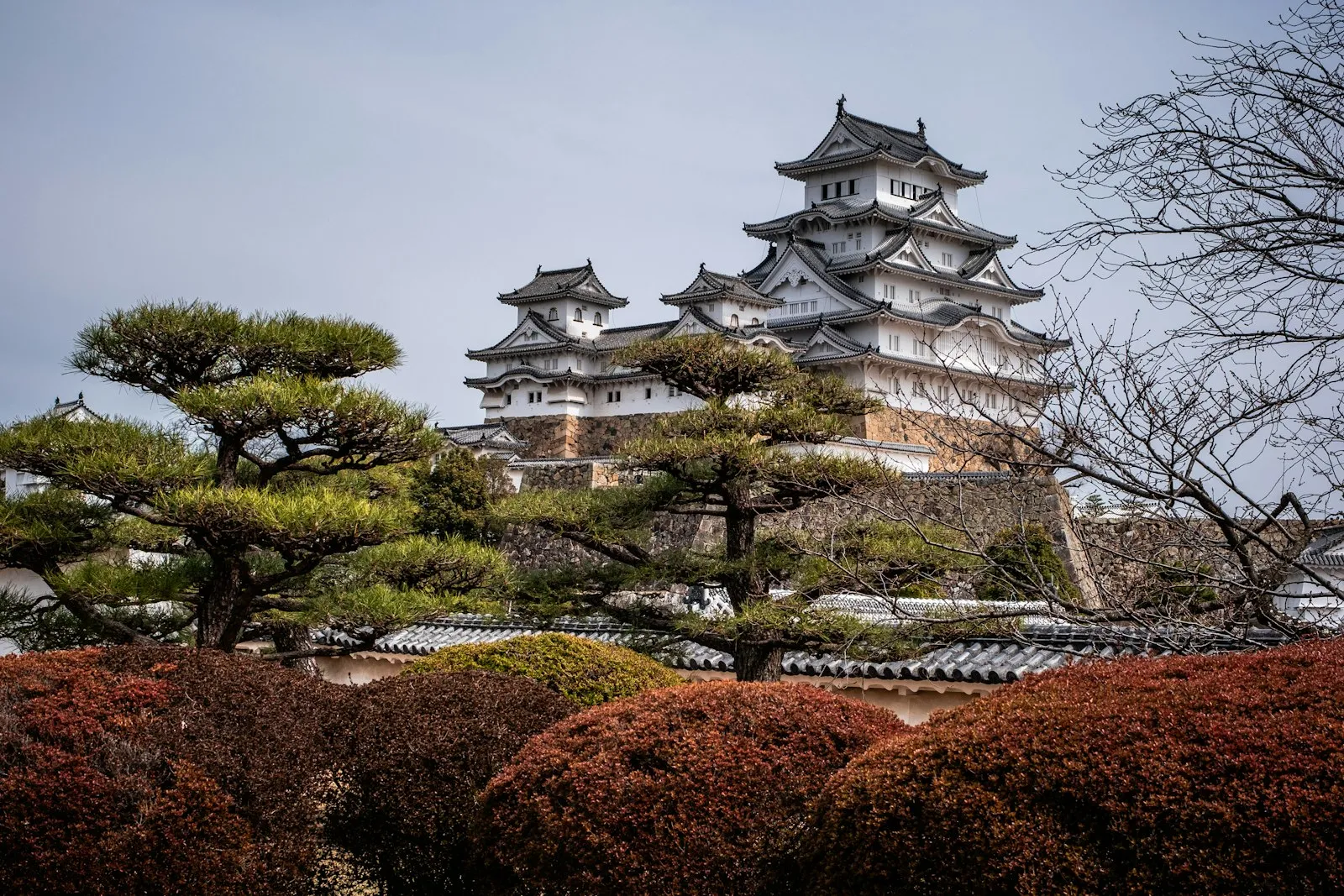
If you see one Japanese castle, see this one. Himeji Castle stands on a hill in Himeji, in Hyogo Prefecture, and is regarded as the finest surviving example of prototypical Japanese castle architecture: a network of 83 structures with the defensive systems of the feudal period still in place. The white plaster gives it its nicknames, Hakuro-jo and Shirasagi-jo, the white egret or white heron castle, for a bird about to take flight. The tenshu, the main keep, served as a storehouse in peacetime and a fortified tower in war, with the daimyo's offices and residence in single-storey buildings beside it and yagura, turrets, around them.
From a 1333 fort to the first UNESCO list
A fort went up on Himeyama hill in 1333, built by Akamatsu Norimura. It was taken down and rebuilt as Himeyama Castle in 1346, remodelled into Himeji Castle two centuries later, and significantly remodelled again from 1581; the expansion is reckoned to have taken 2.5 million man-days of labour. The castle was abandoned in 1871 and some corridors and gates were pulled down to make room for army barracks. Substantial repairs began in 1956, costing 250,000 man-days and 550 million yen. On 11 December 1993 Himeji was registered as one of the first UNESCO World Heritage Sites in Japan.
What you actually walk
The site covers 233 hectares. The complex once had 84 gates, fifteen of them named after the iroha syllabary; 21 gates survive intact today and thirteen still carry those names. The buildings went through restoration from April 2010 and reopened on 27 March 2015, so the white you photograph is recent work rather than weathered plaster. It is the most visited castle in the country, taking over 2,860,000 visitors in 2015, and it passed 40 million visits since the Showa-era restoration on 14 April 2009. Start early in the day and give the keep more time than you think.
Getting there, tickets and staying connected
Himeji is about 1.5 hours west of Osaka by train, which makes the castle a day out from Osaka or Kyoto rather than something you squeeze into an afternoon. Admission is charged at the gate and we have not found a figure from a source we trust, so check the official site rather than a number you read somewhere. The city averages 15.6 degrees over the year, 27.8 in August and 4.4 in January, so a summer visit is hot work on foot. Goodbars sells a Japan eSIM you install at home and switch on when you land; it runs on NTT docomo, Japan's largest mobile network by mobile contracts, and our Japan coverage page shows where it reaches and what independent speed tests measure.
Common questions
Is Himeji Castle a UNESCO World Heritage Site?
Yes. It was registered on 11 December 1993 as one of the first UNESCO World Heritage Sites in Japan, as a complex of 83 structures across 233 hectares.
How do I get to Himeji Castle?
Himeji is about 1.5 hours west of Osaka by train and the castle is in the city itself, which is why most people come as a day trip from Osaka or Kyoto.
Why is it called the White Heron Castle?
For the brilliant white exterior and its supposed resemblance to a bird taking flight. In Japanese it is Hakuro-jo or Shirasagi-jo, white egret or white heron castle.
Will my phone work in Himeji?
docomo does not name Himeji in its published 5G spot lists, and reports LTE population coverage of about 100 percent nationwide in its 2025 sustainability report, so 5G here depends on your handset and the exact spot. Goodbars sells a Japan eSIM you install at home and switch on when you land; it runs on NTT docomo, Japan's largest mobile network by mobile contracts, and our Japan coverage page shows where it reaches and what independent speed tests measure.

Install before landingLAND ONLINE
Set up your eSIM at home and step off the plane already connected. No counter, no passport handed over, no queue.
See the plans- No ID needed
- No contract
- Instant email delivery
- Works on arrival