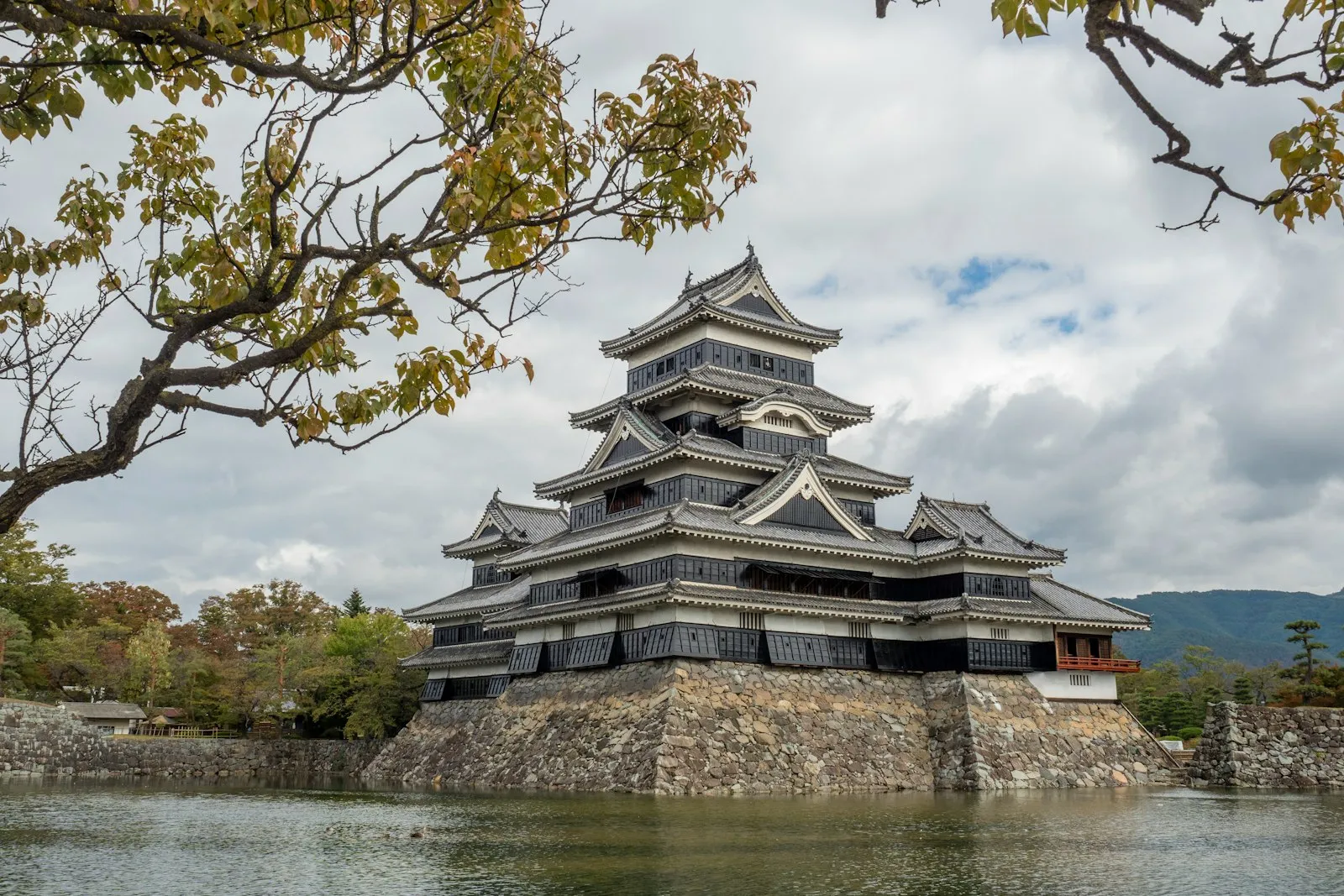
Original keeps, and concrete rebuilds
Twelve original keeps survive in Japan, and most of the famous silhouettes are not among them. The keep, the tenshu, was the tallest part of a castle and the part that burned: in peacetime it served as a storehouse, in war as a fortified tower, while the lord's offices and residence sat in low buildings around it. Matsumoto's keep is one of the twelve survivors and still has its original wooden interiors. Kumamoto's is a concrete reconstruction from 1960. Neither is a fake, they are simply two different visits, and knowing which one you are making changes what you look at.
Himeji: the one to go out of your way for
Himeji Castle is a hilltop complex of 83 structures in Hyogo Prefecture, and it is the largest and most visited castle in Japan. It was registered on 11 December 1993 as one of the first UNESCO World Heritage Sites in the country. The white exterior gives it its nicknames, White Egret and White Heron. The site goes back to a fort built on Himeyama hill in 1333, rebuilt as a castle in 1346 and remodelled heavily in 1581. Restoration work that started in April 2010 ended when the castle reopened to the public on 27 March 2015. Of the 84 gates the complex once had, 21 remain. Himeji is about 1.5 hours west of Osaka by train.
Matsumoto: the original keep on a plain
Matsumoto Castle, originally called Fukashi Castle, stands on a plain in Nagano Prefecture rather than on a hill or among rivers, which makes it a hirajiro, a flatland castle. Its keep was completed in the late sixteenth century and still has its original wooden interiors and external stonework. It is a National Treasure of Japan and one of the twelve surviving tenshu, and four buildings around it are National Treasures too. Its full defences would once have been an interconnected system of walls, moats and gatehouses. Along with Himeji and Kumamoto it is counted among Japan's premier historic castles, and it is the one that rewards a slow lap of the moat.
Kumamoto: a 1960 keep over old stone
Kumamoto Castle is a hilltop castle in Chuo-ku, Kumamoto, and the third of that trio. The keep is a concrete reconstruction built in 1960, 30.3 metres tall, but a number of the original wooden buildings remain and thirteen structures in the complex are designated Important Cultural Property. The grounds are big: roughly 1.6 km from east to west and 1.2 km north to south. Most of the seventeenth-century structures were rebuilt during restoration work between 1998 and 2008. Check what is open before you travel, because work on a castle this size runs for years at a time.
Osaka and Nijo, the two you pass anyway
Osaka Castle, in Chuo-ku, is where Toyotomi Hideyoshi started building in 1583 on the site of the Ishiyama Hongan-ji temple, and it played a major role in the unification of Japan in the sixteenth century. Nijo Castle in Kyoto is a flatland castle of two concentric rings of fortifications, with the Ninomaru Palace, the ruins of the Honmaru Palace and several gardens over 27.5 hectares, of which only 8,000 square metres are buildings. It is one of the seventeen Historic Monuments of Ancient Kyoto inscribed by UNESCO. The palace was donated to the city of Kyoto in 1939 and opened to the public the following year.
Fees, hours and how they fit a trip
We quote no entry fee for any of these five, because we could not verify one from an official source. Check each castle's own site for the fee and the opening hours in the week you go. Fitting them in is easier: Nijo Castle is inside Kyoto and Osaka Castle is in the middle of Osaka, so both are half a morning from a Kansai base, and Himeji is about 1.5 hours west of Osaka by train, which makes it a day out rather than a detour from Tokyo. Matsumoto and Kumamoto are each their own journey. For signal, NTT docomo's May 2026 list names 5G SA spots at JR Kyoto Station and JR Osaka Station, and does not name Himeji, Matsumoto or Kumamoto, where you should expect LTE, which docomo reports at about 100% population coverage, with 5G depending on your handset. Goodbars sells a Japan eSIM you install at home and switch on when you land; it runs on NTT docomo, Japan's largest mobile network by mobile contracts, and our Japan coverage page shows where it reaches and what independent speed tests measure.