

Nara Park
On the map
A park with a herd in it
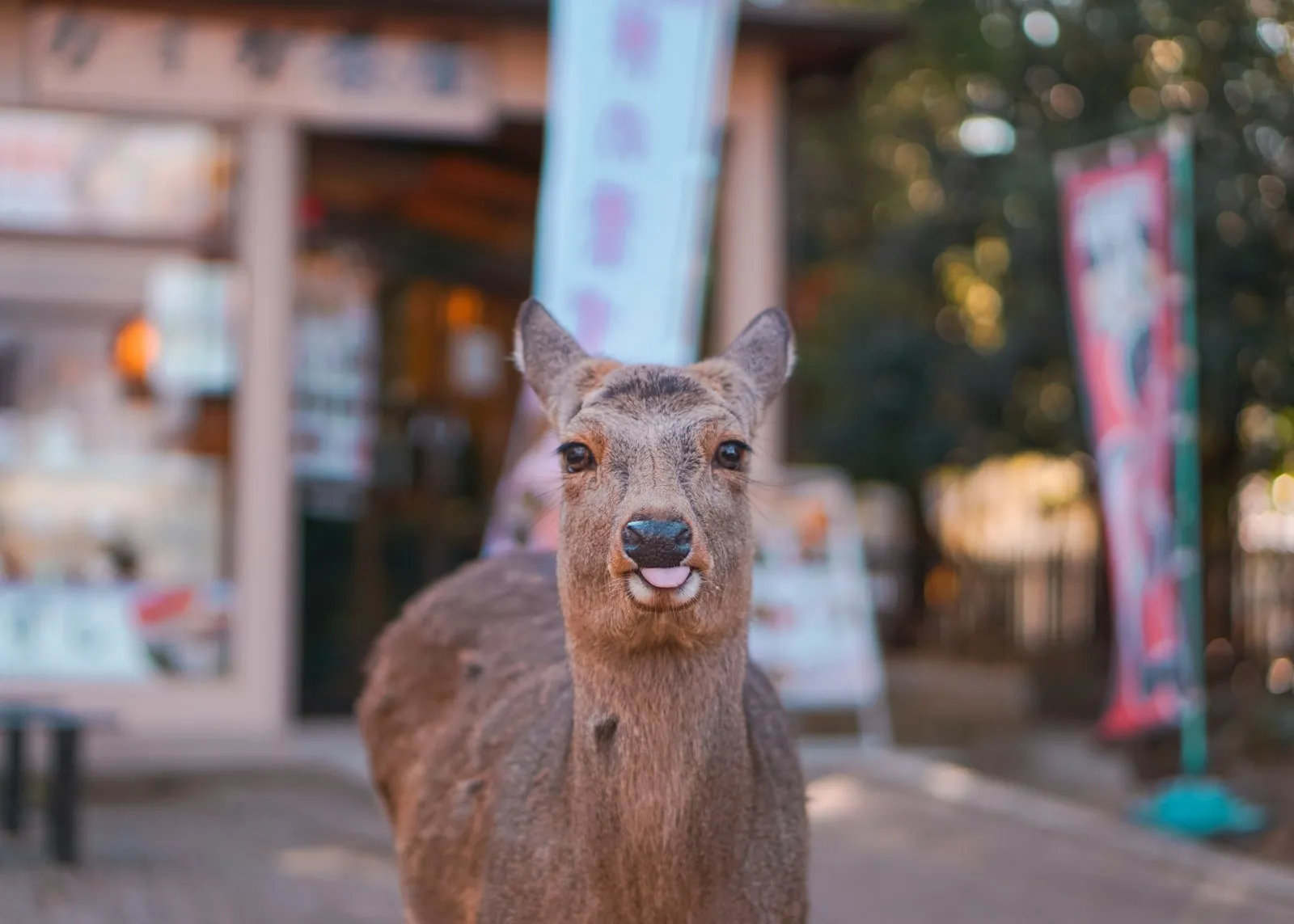
Nara Park is a public park with wild deer living in it. It was established in 1880 at the foot of Mount Wakakusa, which makes it one of the oldest parks in Japan, and Nara Prefecture administers it. Over 1,200 wild sika deer roam it freely, and both the park and the deer carry designations from the Ministry of Education, Culture, Sports, Science and Technology: the park as a Place of Scenic Beauty, the deer as a natural treasure. They are not tame and they are not fenced in. They use the paths, the lawns and, when it suits them, the road.
How big it actually is
The official figure is about 502 hectares. Add the grounds of Todai-ji, Kofuku-ji, Kasuga Grand Shrine and the Nara National Museum, which sit on the edge of the park or inside it, and the area comes to 660 hectares. It reached that size in stages: 14 hectares of Kofuku-ji land in 1880, then Todai-ji, Kasugano and the slopes of Mount Wakakusa in 1889, which took it to 535 hectares, then a reduction to 500 when the temple grounds came back out between 1949 and 1951, then 502 under the Urban Park Act in 1960. Plan half a day, not an hour.
The deer, and the 164 people
At least 164 people were injured by the deer between 2017 and 2018, when there were around 1,500 of them in the park. Keep food out of sight until you are ready, hand it over quickly, do not tease one for a photograph, and keep small children and their snacks close. There is a good reason the animals are protected: a 2023 study by Fukushima University, Yamagata University and Nara University of Education found the Nara Park deer to be a distinct genetic population, separated from the rest of the Kii Peninsula about 1,400 years ago, close to 768, the year Kasuga Grand Shrine was built.
What stands on its edges, and staying connected
Forty-seven buildings on the grounds of Todai-ji, Kofuku-ji, Kasuga Grand Shrine, Shosoin, Shin-Yakushi-ji and Gango-ji are designated National Treasures or Important Cultural Properties, along with 374 works of art and craft, mostly Buddhist statues and religious pieces. That is the real argument for Nara over a quick photograph with a deer. Todai-ji has its own page here, and the Nara page covers getting in from Kyoto or Osaka. Goodbars sells a Japan eSIM you install at home and switch on when you land; it runs on NTT docomo, Japan's largest mobile network by mobile contracts, and our Japan coverage page shows where it reaches and what independent speed tests measure.
Common questions
How many deer live in Nara Park?
Over 1,200 wild sika deer roam the park freely, and in July 2017 there were around 1,500. They are classified as a natural treasure by the education ministry.
Are the Nara deer dangerous?
They are wild animals: at least 164 people were injured by them between 2017 and 2018. Keep food out of sight until you hand it over, do not tease them for a photograph, and keep small children close.
How big is Nara Park?
About 502 hectares officially, or 660 hectares counting the grounds of Todai-ji, Kofuku-ji, Kasuga Grand Shrine and the Nara National Museum on its edges. Give it half a day.
Will my phone work in Nara Park?
docomo's FY2025 pledge lists the area around Nara Station among the city centres where it planned to add 5G Sub6 capacity by March 2026, and its 2025 sustainability report gives LTE population coverage of about 100 percent nationwide. Download a map of the park: it covers about 502 hectares. Goodbars sells a Japan eSIM you install at home and switch on when you land; it runs on NTT docomo, Japan's largest mobile network by mobile contracts, and our Japan coverage page shows where it reaches and what independent speed tests measure.

Install before landingLAND ONLINE
Set up your eSIM at home and step off the plane already connected. No counter, no passport handed over, no queue.
See the plans- No ID needed
- No contract
- Instant email delivery
- Works on arrival